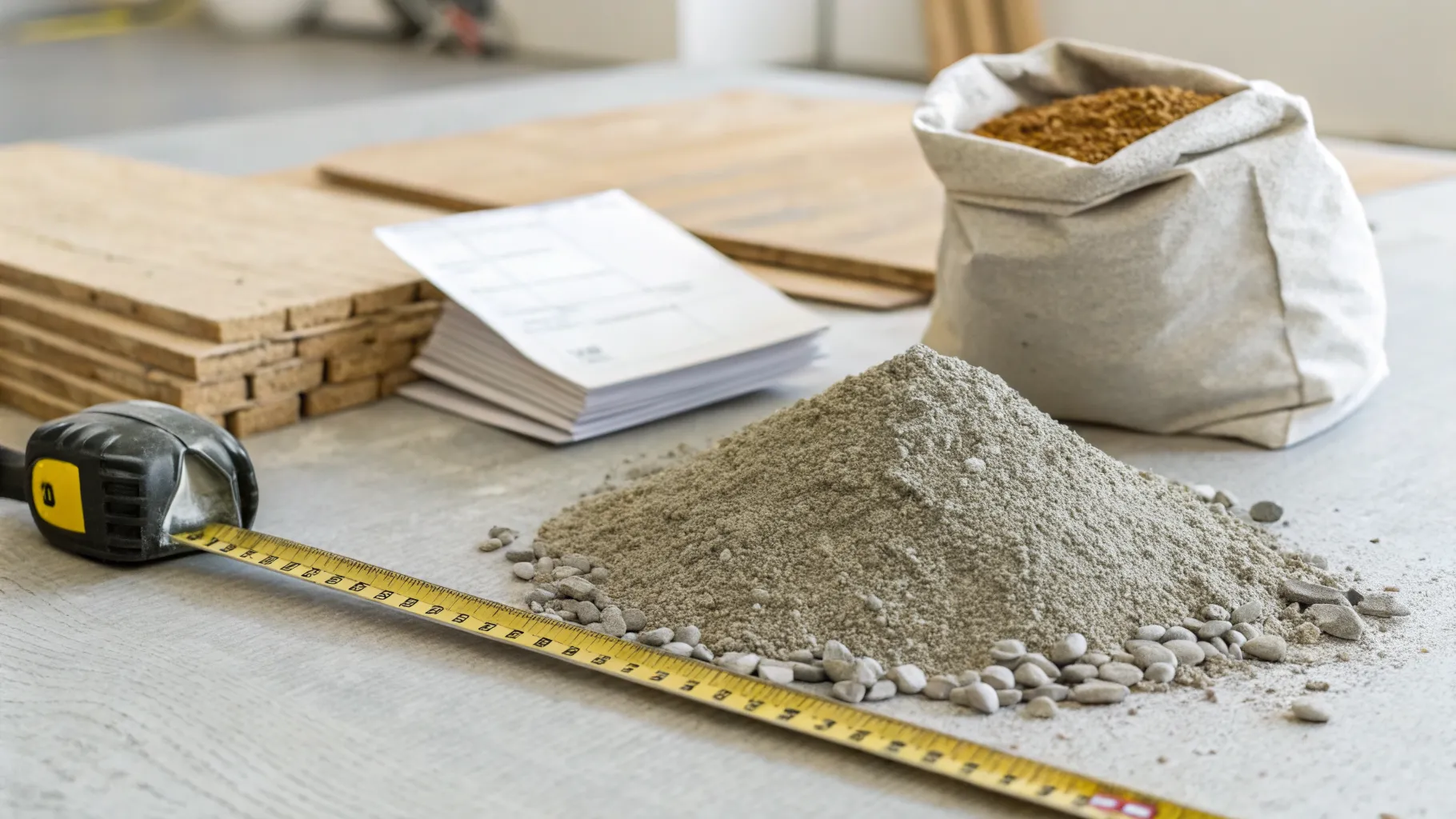
Enter your slab or footing size, pick a mix, and this concrete calculator works out the cement, sharp sand and ballast you need, plus the total cubic metres for ordering ready-mix. It builds in 8% for waste and spillage.
Concrete slab and mix calculator
Ratio shown as cement : sharp sand : ballast, by volume.
Find a building supplier near you
Compare local builders merchants and ready-mix suppliers for cement, sharp sand and ballast.
Related guides
Mixing and pricing the pour? Start with these.
How it is calculated
The calculator runs in two stages: work out the volume, then split that volume into materials by the mix ratio.
Volume. Concrete volume is length times width times depth, with depth converted from millimetres to metres:
Volume (m³) = Length (m) × Width (m) × Depth (mm) ÷ 1000
We then add 8% for waste, spillage, ground that is not perfectly level, and over-dig in footings. So a slab that calculates at 1.2 m³ is ordered as roughly 1.3 m³.
Materials. Dry sand, ballast and cement pack down when water is added and the mix is compacted, so you need more dry material than the finished volume suggests. We use the standard dry volume factor of 1.55, meaning 1 m³ of finished concrete needs about 1.55 m³ of dry materials. That dry volume is split by the mix ratio, then converted to bags and tonnes with these UK trade figures:
- Sharp sand: 1.6 tonnes per m³
- Ballast (all-in aggregate): 1.75 tonnes per m³
- Cement: 25 kg per bag, batched at about 680 kg per m³ of its share of the mix
The three mixes use these ratios of cement : sharp sand : ballast, by volume:
- General use, 1:2:4 for paths, shed bases and general slabs
- Foundation, 1:3:6 for footings, trench fill and mass concrete
- Strong, 1:1.5:3 for driveways and anything carrying heavy or structural loads
Worked example
Say you are pouring a 4 m by 3 m shed base at 100 mm deep, using a general 1:2:4 mix.
- Volume = 4 × 3 × 100 ÷ 1000 = 1.2 m³.
- Add 8% waste: 1.2 × 1.08 = 1.30 m³. This is what you order as ready-mix.
- Dry materials: 1.30 × 1.55 = 2.01 m³, split 1:2:4 over 7 parts.
- Cement: (2.01 × 1/7) × 680 ÷ 25 ≈ 8 bags of 25 kg.
- Sharp sand: (2.01 × 2/7) × 1.6 ≈ 0.92 t.
- Ballast: (2.01 × 4/7) × 1.75 ≈ 2.01 t.
As a sanity check, 1 m³ of mixed concrete weighs roughly 2.3 to 2.4 tonnes, so a 1.3 m³ pour is about 3 tonnes of materials in total. The figures above add up in that range.
Frequently asked questions
How does this concrete calculator work?
It multiplies length by width by depth to get cubic metres, adds 8% for waste, then splits that volume into cement bags, sharp sand and ballast using the mix ratio you choose and standard UK material densities. It also gives the total m³ so you can price ready-mix.
How do I calculate ballast for concrete?
Work out the concrete volume in cubic metres, scale it by the dry volume factor of 1.55, take the ballast share of the mix ratio (for a 1:2:4 mix that is 4 parts out of 7), then multiply by 1.75 tonnes per m³. This concrete ballast calculator does that step for you and shows the ballast in tonnes.
Can I use this as a concrete slab calculator for the UK?
Yes. Enter the slab length and width in metres and the thickness in millimetres. Most domestic slabs are 100 mm, a driveway taking vehicles is usually 150 mm, and a light path can be 75 mm. The calculator returns the materials and the total m³ in UK units.
What mix should I use for a shed base?
A general 1:2:4 mix at 100 mm deep suits most shed bases and garden buildings. For a base that will carry a heavier building or a vehicle, switch to the strong 1:1.5:3 mix and consider 150 mm. This shed base concrete mix calculator updates the cement, sand and ballast as soon as you change the mix.
How do I work out ready-mix concrete cost?
Take the total m³ from the calculator and multiply by your supplier's rate per m³. As a rough UK guide, ready-mix runs around 90 to 130 pounds per m³ delivered, before any part-load or short-load charge, so always get a live quote. This tool gives the volume that a ready mix concrete price calculator needs as its input; we do not store live prices because they move with cement and fuel costs.
Is ballast the same as aggregate?
Ballast is a pre-blended mix of sharp sand and gravel, often called all-in aggregate, sold ready to add cement and water. If you batch separately you buy sharp sand and gravel as two materials. This concrete aggregate calculator shows sharp sand and ballast as separate lines so it works either way: buy ballast for the combined figure, or buy sand and gravel individually.
Should I order bagged concrete, mix on site, or get ready-mix?
For under about 0.2 m³, bagged ready-mixed concrete is simplest. From roughly 0.2 to 1.5 m³, buying cement, sand and ballast and mixing on site is usually cheapest. Above about 1.5 m³, ordering ready-mix saves a lot of labour and gives a more consistent mix, especially in one continuous pour.
Why does the calculator add 8% waste?
Some concrete is always lost to spillage, material left in the mixer or barrow, uneven ground, and over-dig in trenches. An 8% allowance covers normal site losses so you are not caught short mid-pour. If your shuttering is tight and the base is well prepared, you may use a little less; rounding the cement bags up covers small differences.