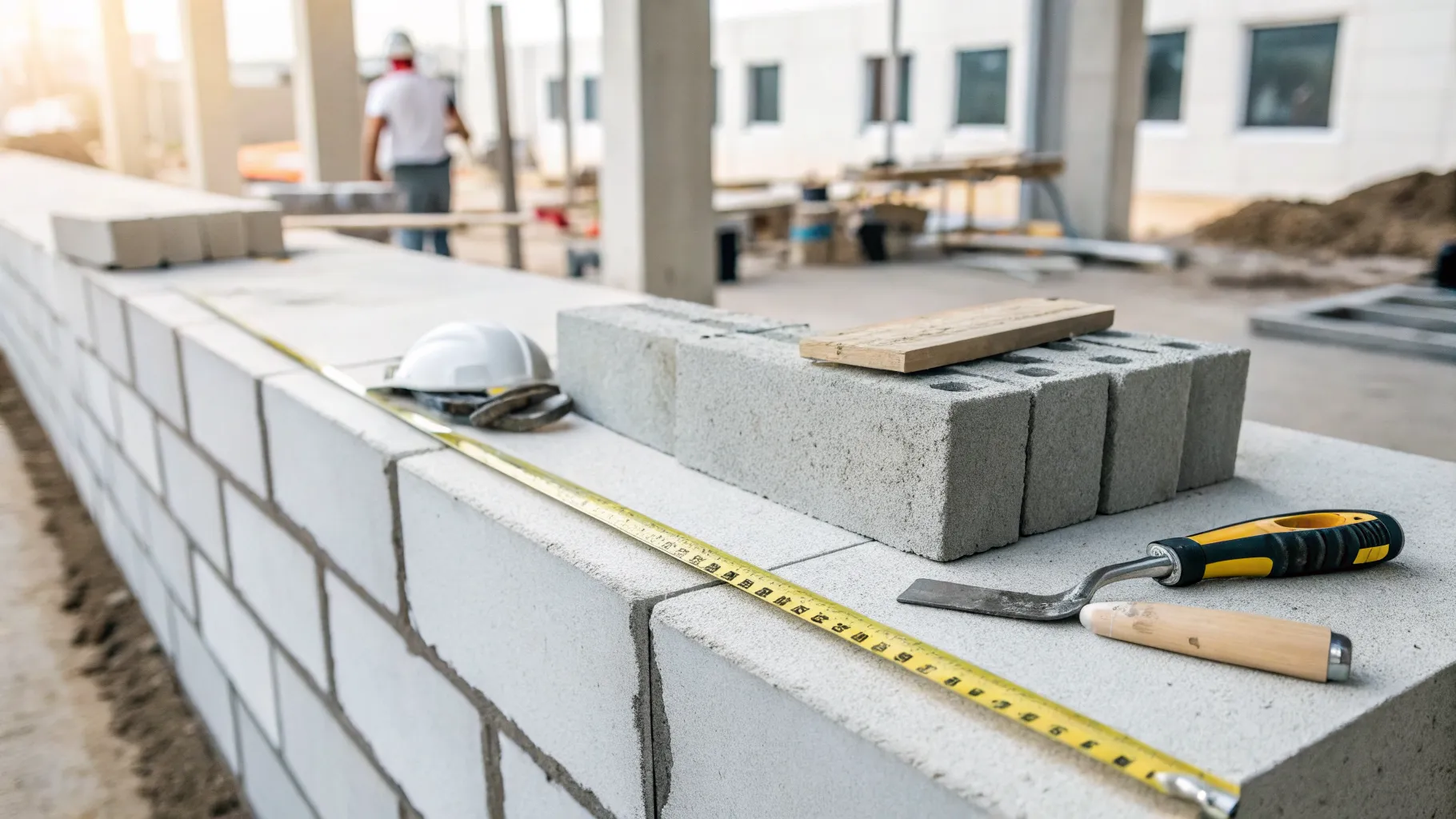
Enter your wall size and we'll work out how many standard concrete blocks you need. UK blocks have a 440 x 215mm face, and once you add a 10mm mortar joint each block covers a 450 x 225mm area, so roughly 9.88 blocks fill every square metre.
Concrete block calculator
The result includes a 5% wastage allowance to cover cuts, breakages and the odd dud block. Buy in full packs and keep a few spares back for repairs.
Find a building supplier near you
Compare local builders merchants for concrete blocks, mortar and everything else on the materials list.
Related guides
Planning the blockwork? These guides cover sizing, mortar and how blocks compare to brick.
How it is calculated
A standard UK concrete block has a face of 440mm x 215mm. You never lay a block on its own though: it sits in a bed of mortar with a joint between each one. The trade allows a 10mm joint, so the area each block actually claims on the wall is the coordinating size of 450mm x 225mm.
That gives the figure every block calculator turns on:
Blocks = (wall area − openings) ÷ 0.10125, then add 5% wastage and round up.
Working the numbers:
- Coordinating area per block = 0.450m x 0.225m = 0.10125 m²
- Blocks per square metre = 1 ÷ 0.10125 = 9.88 blocks/m²
- Wastage allowance = 5% for cuts, breakages and offcuts
This counts a single skin of blockwork. A standard cavity wall has two skins (often a brick outer leaf and a block inner leaf, or block on block), so for a full cavity wall in blocks you would run the calculation for each leaf.
Worked example
Say you are building a single skin garden wall 10m long and 2.4m high, with no openings:
- Wall area = 10 x 2.4 = 24 m²
- Blocks before wastage = 24 ÷ 0.10125 = 237
- Add 5% = 237 x 1.05 = 248.9, rounded up to 249 blocks
If that wall had a 2.1 m² doorway, you would subtract it first: (24 − 2.1) = 21.9 m², which works out at 228 blocks including wastage.
Frequently asked questions
How does this concrete block calculator work?
It takes your wall length and height in metres, multiplies them for the area, subtracts any openings you enter, then divides by 0.10125 m² (the area one standard block covers with its mortar joint). It adds 5% for wastage and rounds up to whole blocks.
How many concrete blocks are there per square metre?
For standard 440 x 215mm blocks laid with 10mm joints, there are 9.88 blocks per square metre (1 ÷ 0.10125). Many builders round this to 10 blocks/m² for a quick estimate, which also leaves a small margin for waste.
Does this work as a breeze block calculator or cement block calculator?
Yes. Breeze blocks, cinder blocks, cement blocks and modern aircrete or dense concrete blocks all share the same standard 440 x 215mm face in the UK, so the block count is identical whatever the block is made from. Only the weight and price per block change, not how many you need.
Is this a block wall calculator for a full cavity wall?
The tool counts one skin of blockwork. A cavity wall is built as two separate leaves, so for a block wall calculator covering both skins, run the figures twice (once per leaf) and add them together. If one leaf is facing brick, use a brick and block calculator approach: blocks for the inner leaf, bricks for the outer.
How much wastage should I allow for concrete blocks?
5% is a sensible default and is built into this blocks calculator. Add a little more (up to 10%) for walls with lots of cuts, curves, piers or openings, where you create more offcuts that cannot be reused.
How much mortar do I need for the blocks?
As a rough guide, allow about one bag of cement and the matching sand per square metre of single skin blockwork at a 1:5 mix, or roughly 0.02 m³ of mortar per m². This concrete block calculator UK estimate covers the blocks themselves; price the mortar separately once you have the block count.
What size is a standard UK concrete block?
The standard block face is 440mm long x 215mm high. Thickness varies (100mm and 140mm are the common ones) but thickness does not change how many blocks cover the wall face, only the wall's depth and weight.
Why does the result round up instead of giving a decimal?
You cannot buy part of a block, so the calculator always rounds up to the next whole block after adding wastage. Buy in full packs where you can, and keep a few spare blocks back for any future repairs or alterations.