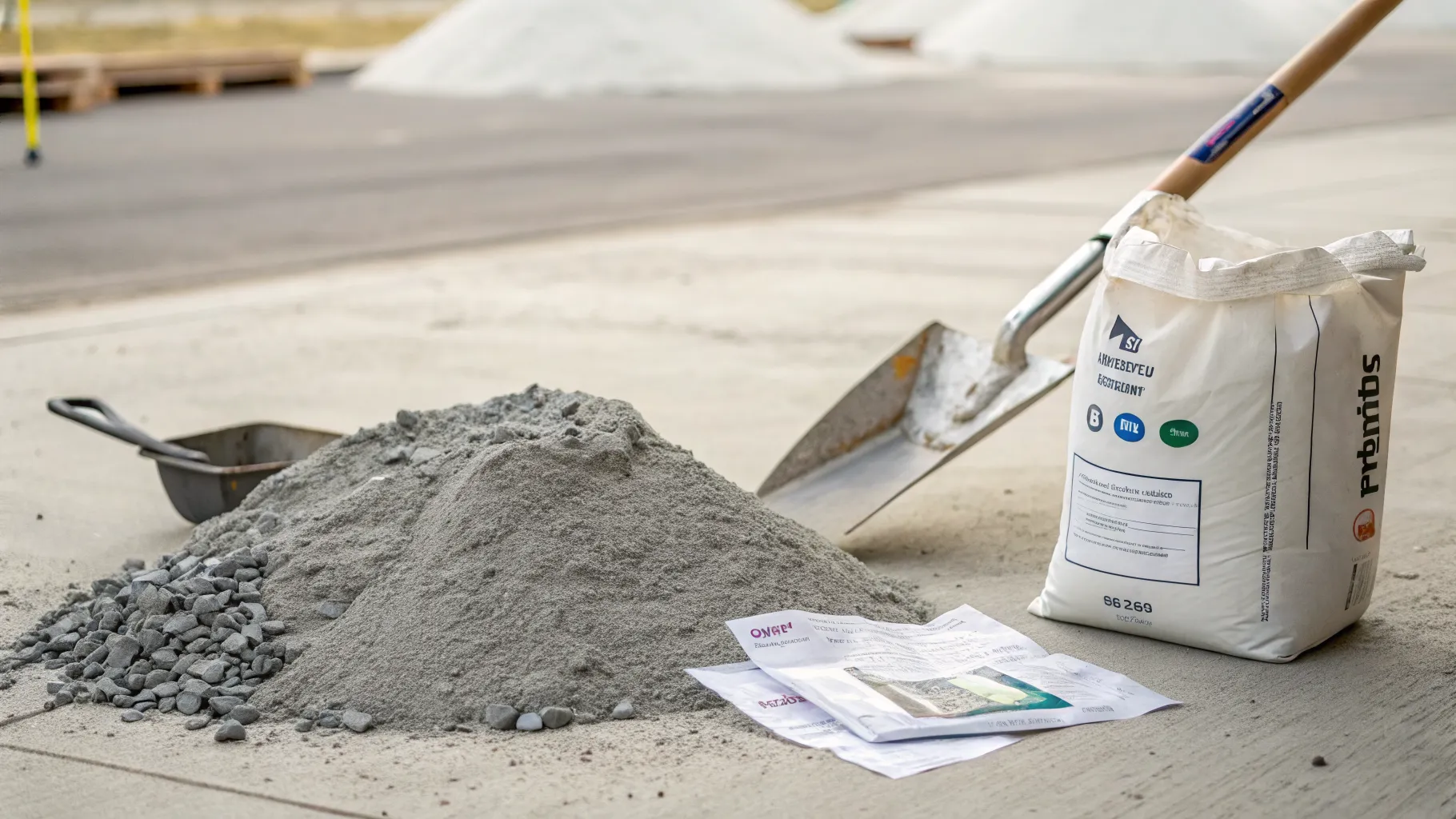
Enter the size of your slab and pick a mix, and this ballast calculator works out the ballast and cement you need for the concrete. It is built for everyday jobs like a shed base, footings or a small slab, and it adds 10% for waste.
Ballast and cement calculator
1:5 suits a general shed base or path. 1:6 is the usual mix for strip footings. 1:4 gives a stronger slab for heavier loads.
The figures include a 10% allowance for waste, spillage and uneven ground. Ballast is sold loose by the tonne or in bulk bags of around 0.8 tonnes, and cement here is counted in 25kg bags, so the totals are rounded up to whole bags.
Find a building supplier near you
Compare local builders merchants for ballast and cement, by the bulk bag or loose-tipped.
Related guides
Ballast plus cement makes concrete. These guides cover the mix and the cost.
How it is calculated
The calculator works in three steps, all from the dimensions you enter.
- Volume of concrete. Length (m) x width (m) x depth (m) gives cubic metres.
Depth is entered in millimetres, so it is divided by 1000 first:
volume = L × W × (depth mm ÷ 1000). - Ballast. One cubic metre of concrete uses roughly 1.75 tonnes of ballast. Multiply the volume by 1.75 to get tonnes, then divide by 0.8 for the number of bulk bags.
- Cement. The amount comes from the mix ratio by volume. Per cubic metre of concrete we use about 6 bags of 25kg cement for a 1:5 mix, 5 bags for 1:6, and 7.5 bags for 1:4.
Every figure is then increased by 10% so you are not left short by waste, spillage or ground that is not quite level. A bulk bag is taken as 0.8 tonnes, which is the common builders' merchant size.
Worked example: a 3m x 3m shed base
Say you are pouring a shed base 3m long, 3m wide and 100mm deep, using a general 1:5 mix.
- Volume: 3 x 3 x 0.1 = 0.9 m³
- With 10% waste: 0.9 x 1.10 = 0.99 m³
- Ballast: 0.99 x 1.75 = 1.73 tonnes, which is 3 bulk bags at 0.8t each
- Cement: 0.99 x 6 = 5.94, rounded up to 6 bags of 25kg
So a typical 3m x 3m, 100mm shed base needs about 1.75 tonnes of ballast and six bags of cement. Without the waste allowance it works out near 1.6 tonnes and five to six bags, which is a useful sanity check against the merchant's quote.
Frequently asked questions
How does the ballast and cement calculator work?
It multiplies your length, width and depth to get the concrete volume in cubic metres, then applies 1.75 tonnes of ballast per cubic metre and the cement bags set by your chosen mix ratio. A 10% waste allowance is added before the totals are rounded up to whole bags.
How much ballast and cement do I need for a shed base?
For a common 3m x 3m base at 100mm deep you need about 1.75 tonnes of ballast and six 25kg bags of cement at a 1:5 mix. For other sizes, put your own measurements into the ballast and cement calculator above and it gives the exact figures for a shed base.
What is the right ballast to cement ratio?
A 1:5 cement to ballast mix by volume suits a general shed base, path or small slab. Use 1:6 for strip foundations and footings, and 1:4 where you want a stronger slab for heavier loads such as a driveway or a workshop floor.
How many bulk bags of ballast are in a tonne?
A bulk bag holds roughly 0.8 tonnes, so a little over one bulk bag makes a tonne. The ballast calculator rounds up to whole bulk bags, because merchants sell them as full bags rather than part bags.
How much does a cubic metre of concrete weigh in ballast?
One cubic metre of mixed concrete needs about 1.75 tonnes of ballast, plus the cement. The finished concrete itself weighs around 2.4 tonnes per cubic metre once the cement and water are added.
How many 25kg bags of cement are in a tonne?
A tonne is 1000kg, so it holds 40 bags of 25kg cement. At a 1:5 mix you use about six bags per cubic metre of concrete, so a tonne of cement covers roughly six and a half cubic metres of that mix.
Can I use this for footings as well as a shed base?
Yes. Choose the 1:6 mix for strip footings, enter the trench length, width and depth, and the calculator gives the ballast and cement the same way. For deep or load-bearing foundations, confirm the size and mix with a structural engineer first.