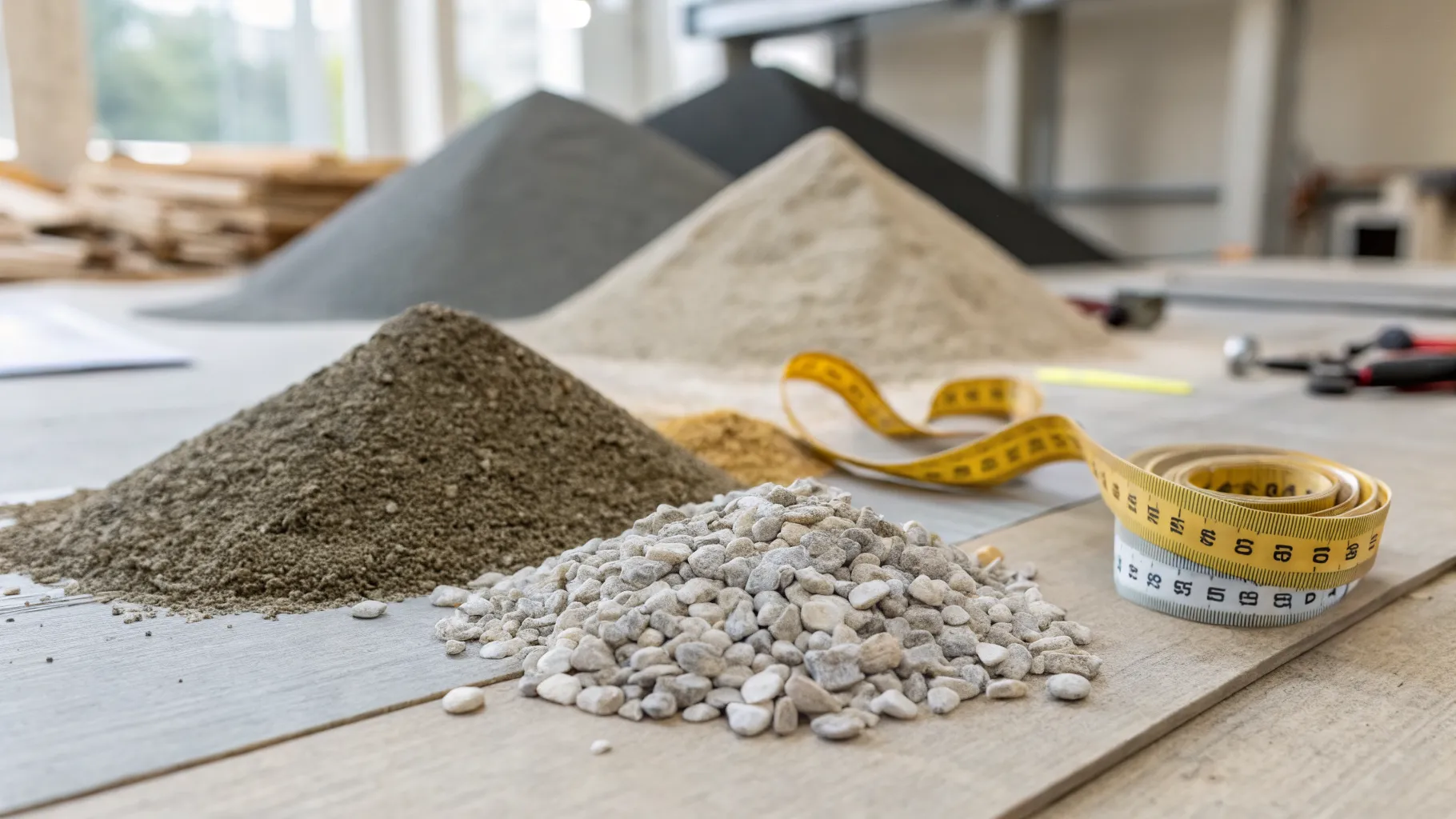
Enter the area you are covering and how deep you need it, choose the material, and this aggregate calculator works out the tonnes and the number of bulk bags to order. It doubles as a sub base calculator: pick MOT Type 1 and it adds a compaction allowance for you.
Aggregate calculator
The result already includes a 10% compaction allowance when you choose MOT Type 1 sub-base, because hardcore consolidates when it is rolled or whacked. The other materials are loose laid, so no allowance is added to those. Always round up when you order: part bags and part loads cost the same.
Find a building supplier near you
Compare local builders merchants and aggregate yards for Type 1, gravel, sand and ballast.
Related guides
Laying or pricing aggregate? These guides go deeper.
How it is calculated
Aggregate is sold by weight, so the calculator turns your measurements into a volume and then into tonnes using the material density. The formula is:
tonnes = length (m) × width (m) × depth (mm) ÷ 1000 × density (t/m³)
Dividing the depth by 1000 converts millimetres to metres, which gives a volume in cubic metres. Multiplying by the density converts that volume into tonnes. These are the densities used, based on typical supplied (loose) weights for UK aggregates:
- MOT Type 1 sub-base: 2.1 t/m³ (crushed limestone or granite hardcore)
- Gravel / shingle: 1.75 t/m³ (rounded stone, 10 to 20 mm)
- Sharp sand: 1.6 t/m³ (grit sand for bedding and concrete)
- Decorative aggregate: 1.5 t/m³ (slate, chippings, cobbles)
For MOT Type 1 only, the calculator adds a 10% allowance on top, because sub-base loses volume when it is compacted with a roller or plate compactor. One bulk (jumbo) bag holds about 0.8 tonnes, so the calculator divides the tonnes by 0.8 and rounds up to whole bags.
Worked example
Say you are laying a sub-base for a 5 m × 4 m driveway at 100 mm deep, using MOT Type 1:
- Area = 5 × 4 = 20 m²
- Depth = 100 mm = 0.1 m
- Volume = 20 × 0.1 = 2 m³
- Raw tonnes = 2 × 2.1 = 4.2 t
- Plus 10% compaction = 4.2 × 1.10 = 4.62 t
- Bulk bags = 4.62 ÷ 0.8 = 5.78, rounded up to 6 bags
As a quick sanity check, a thinner job: 20 m² of gravel at 50 mm deep is 20 × 0.05 × 1.75 = 1.75 tonnes, which is around 3 bulk bags.
Frequently asked questions
How does this aggregate calculator work?
It multiplies your length and width to get the area, multiplies that by the depth (converted from millimetres to metres) to get the volume in cubic metres, then multiplies the volume by the material density to get tonnes. It then divides by 0.8 tonnes to estimate bulk bags. Pick the aggregate type from the dropdown and the correct density is applied automatically.
How do I calculate sub base for a driveway or patio?
To calculate sub base, measure the length and width of the area, decide the compacted depth you need, then enter those with MOT Type 1 selected. The tool gives the tonnes including a 10% compaction allowance. A typical driveway sub-base is 100 to 150 mm deep, while a patio or path base is often 75 to 100 mm.
Is this a MOT sub base calculator?
Yes. Choose "MOT Type 1 sub-base" and it works as a MOT sub base calculator, using a density of 2.1 t/m³ and adding 10% for compaction. MOT Type 1 is the standard graded hardcore for driveways, patios, sheds and shed bases across the UK.
How many tonnes are in a bulk bag of aggregate?
A bulk bag (also called a jumbo or tonne bag) typically holds about 0.8 tonnes of aggregate when filled, though suppliers vary between roughly 0.75 and 0.9 tonnes. This calculator uses 0.8 tonnes per bag and rounds up, so you do not come up short.
What depth of sub base do I need?
For foot traffic, paths and patios, 75 to 100 mm of compacted MOT Type 1 is usual. For driveways taking cars, aim for 100 to 150 mm, and for occasional heavy vehicles go to 150 mm or more over a suitable subgrade. Soft or clay ground may need a geotextile membrane and extra depth, so confirm with your groundworker.
How do I convert cubic metres of aggregate to tonnes?
Multiply the cubic metres by the material density. For example 1 m³ of MOT Type 1 is about 2.1 tonnes, 1 m³ of gravel is about 1.75 tonnes, and 1 m³ of sharp sand is about 1.6 tonnes. The aggregate calculator above does this conversion for you once you enter the measurements.
Does the aggregate calculator work in the UK with metric units?
Yes, this is a UK aggregate calculator built around metric measurements: metres for length and width, millimetres for depth, and tonnes for the result. UK suppliers sell aggregate by the tonne and by the bulk bag, which is exactly what the breakdown reports.
Should I order extra aggregate?
It is sensible to add a small margin for spillage, uneven ground and settlement, on top of the compaction allowance already built in for sub-base. Rounding up to whole bulk bags usually covers it. If you are buying loose by the tonne, ordering 5 to 10% extra avoids a second part-load delivery charge.