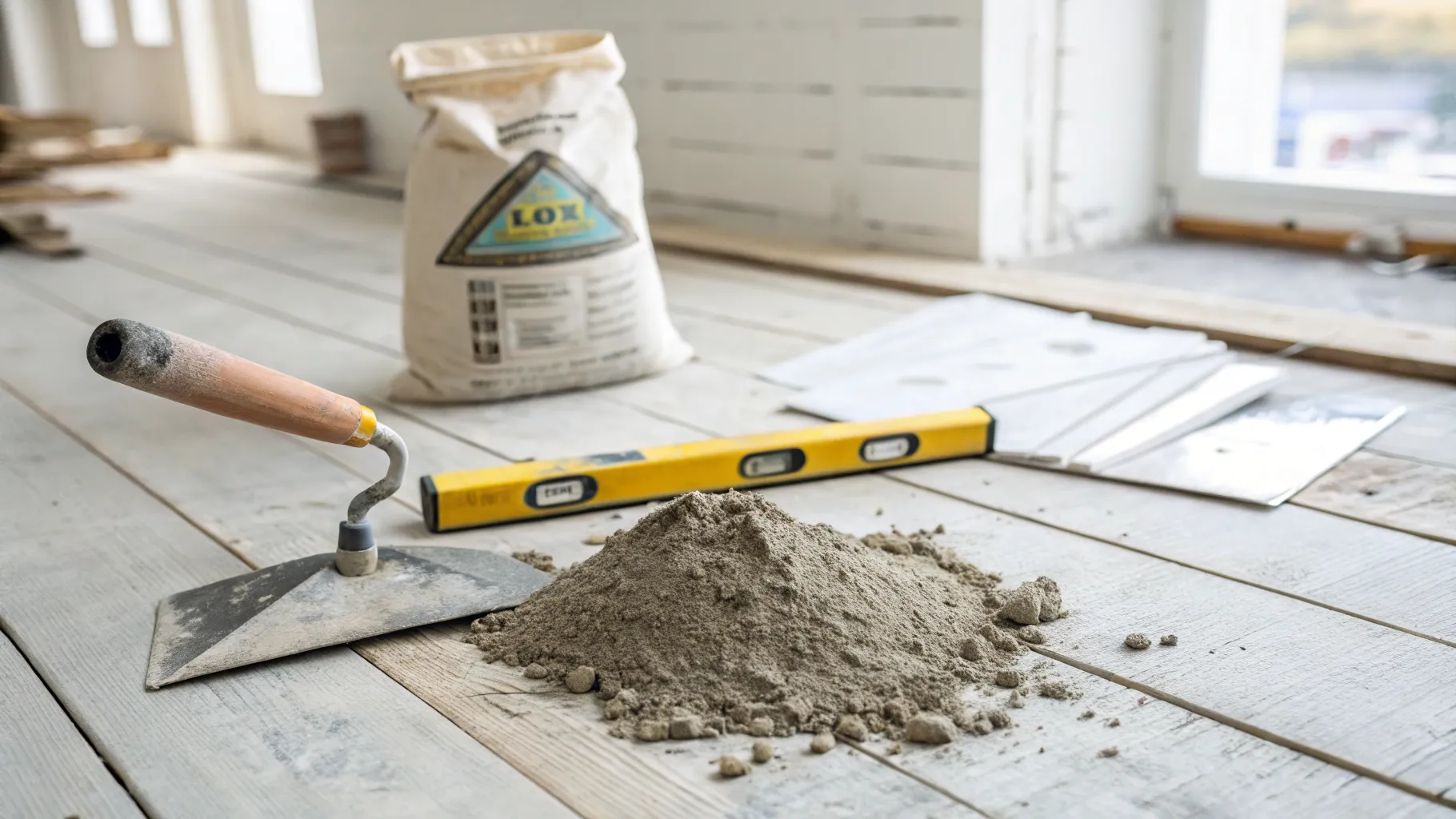
Enter the job and we will work out the sand and cement you need: volume first, then sand in tonnes and bulk bags, then 25kg cement bags. Works for paving beds, patios, single-skin brickwork and floor screed, with a wastage allowance built in.
What are you mixing for?
Find a building supplier near you
Compare local builders merchants for building sand, sharp sand and cement, by the bag or the bulk bag.
Related guides
Getting the mix right matters as much as the quantity.
How it is calculated
The calculator works in two steps: first it finds the volume of mortar or screed you need, then it converts that volume into sand and cement.
Step 1, the volume. How the area becomes a volume depends on the job:
- Paving / patio bed: area (m²) × 0.03 m³/m². That is the volume of a full mortar bed for slabs, roughly 30mm of bedding mortar per square metre.
- Single-skin brickwork: area (m²) × 0.022 m³/m². That is the mortar in the bed and perpend joints of a half-brick (single-skin) wall.
- Floor screed: area (m²) × thickness (mm) ÷ 1000. So 50mm over 10 m² is 10 × 0.05 = 0.5 m³.
Step 2, the materials. We add 10% for wastage, then convert the volume using the standard trade figures for a 4:1 mix:
- Sand: about 1.6 tonnes per cubic metre of finished mortar or screed. A bulk (jumbo) bag holds roughly 850 kg, so 1.6 t is just under two bulk bags.
- Cement: about 10 × 25 kg bags per cubic metre at 4:1. At a leaner 5:1 mix it drops to about 8 bags per cubic metre. The sand stays the same because the cement fills the gaps between the sand grains rather than adding much bulk.
The ratio is by volume, which is how a mix is actually batched on site (for example four shovels of sand to one of cement for 4:1).
Worked example
Say you are laying a patio of 20 m² on a full mortar bed at 4:1.
- Volume: 20 × 0.03 = 0.6 m³
- Add 10% wastage: 0.6 × 1.10 = 0.66 m³
- Sand: 0.66 × 1.6 = 1.06 t, so order 2 bulk bags (or 1.06 t loose)
- Cement: 0.66 × 10 = 6.6, so 7 × 25 kg bags
Frequently asked questions
How much sand and cement do I need? Is there a calculator?
Yes, the tool above is the calculator. Enter your area in square metres, pick the job (paving bed, brickwork or screed), choose a mix ratio, and it returns the sand in tonnes and bulk bags plus the number of 25 kg cement bags, with 10% wastage already added.
How do I use the sand and cement calculator for a patio or paving?
Choose the "Paving / patio bed" mode and enter the patio area (length × width in metres). That mode uses a full bedding-mortar volume of 0.03 m³ per square metre, which suits slabs laid on a solid mortar bed. A 4:1 mix is the usual choice for patios because it is stronger and stands up to weather.
How do I calculate sand and cement for brickwork?
Pick "Single-skin brickwork" and enter the wall area in square metres. The calculator allows 0.022 m³ of mortar per square metre for the bed and perpend joints of a half-brick wall, then splits it by your chosen ratio. A 5:1 mix is common for general bricklaying and blockwork; use 4:1 for exposed or below-ground work.
What is the sand to cement ratio for screed?
A sand and cement floor screed is usually mixed at 4:1 (four parts sharp sand to one part cement) by volume. Select "Floor screed", enter the area and the thickness in millimetres, and the calculator converts that to a volume and then to materials. Bonded screeds are often 40 to 50mm thick; unbonded and floating screeds are thicker.
How many bags of cement per cubic metre?
At 4:1 by volume you need about 10 × 25 kg cement bags per cubic metre of mortar or screed, with roughly 1.6 tonnes of sand. At a leaner 5:1 mix it is about 8 bags of cement per cubic metre with the same amount of sand. The calculator rounds the bag count up so you are not left short.
How much does a bulk bag of sand cover?
A bulk (jumbo) bag of sand holds around 850 kg, which is roughly 0.5 to 0.55 m³. In a 4:1 mortar that is enough sand for a little over half a cubic metre of finished mortar. The calculator gives the sand both in tonnes and as a rounded-up number of bulk bags so you can order whichever way your supplier sells it.
Should I use sharp sand or building (soft) sand?
Use soft (building) sand for bricklaying and pointing mortar because it works smoothly under the trowel. Use sharp (grit) sand for floor screeds and paving beds where you want strength and less shrinkage. The quantities in this calculator apply to either; only the type of sand changes with the job.
Why does the calculator add 10% wastage?
Some mortar is always lost to spillage, to filling an uneven sub-base, and to the bit left in the mixer and on the spot board. A 10% allowance covers normal site losses on a typical job. For a very rough or uneven base, or a small mix where waste is proportionally higher, round up an extra bag.