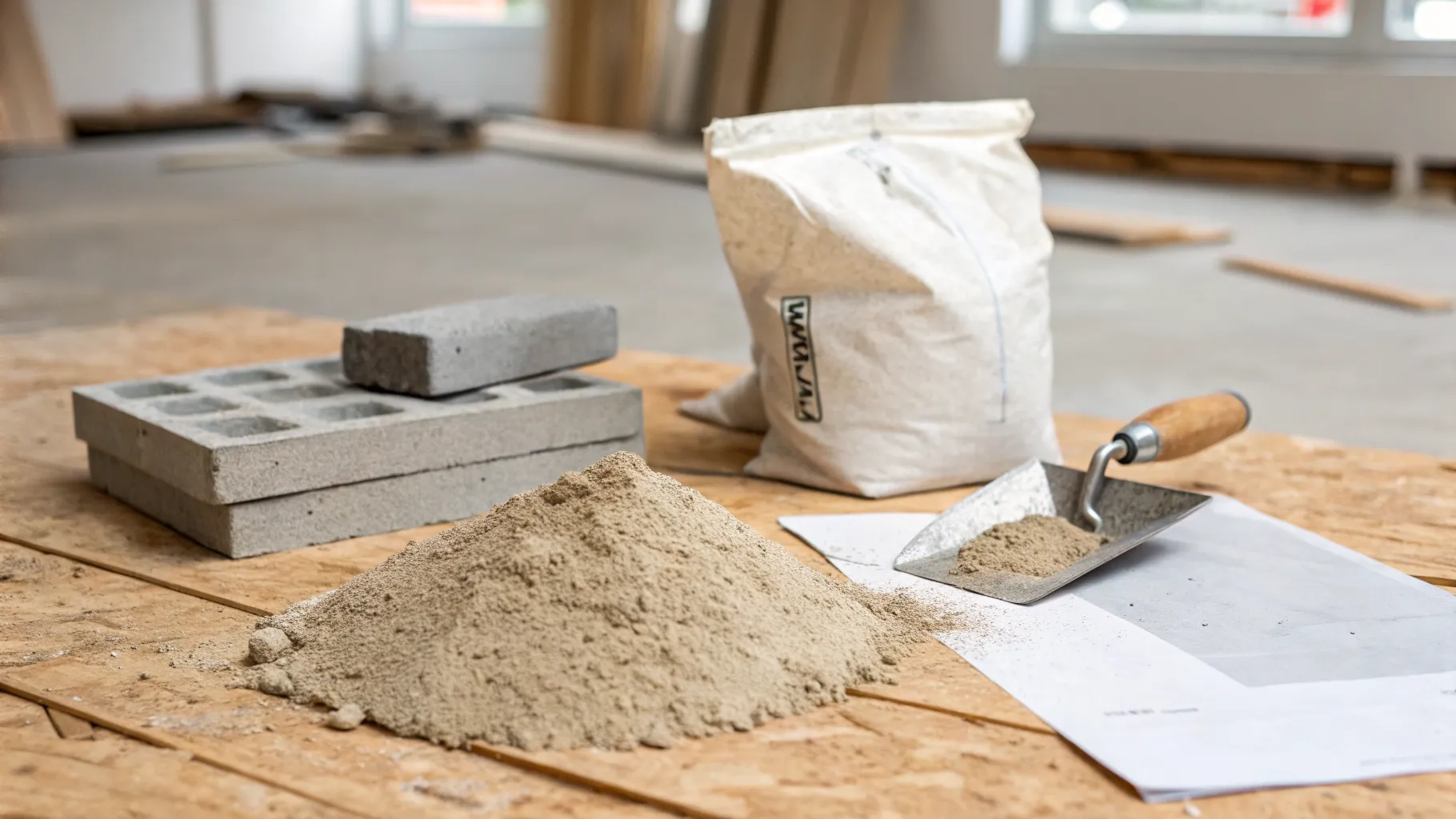
Work out how much mortar you need, then how that splits into sand and cement, either from the wall area or from the number of bricks or blocks you are laying. A 10% wastage allowance is added so you do not run short mid-course. Patio bedding mode is included.
How do you want to measure the job?
Figures include a 10% wastage allowance for spillage, joints and a part-used mixer load. Sand is soft building sand; cement is 25kg bags.
Find a building supplier near you
Compare local builders merchants for building sand, cement, plasticiser and lime for your mortar.
Related guides
Mix it right and estimate the wall while you are here.
How it is calculated
The calculator runs in two steps. First it works out the total volume of wet mortar the job needs. Then it splits that volume into sand and cement for your chosen mix.
Step 1: mortar volume. The tool uses standard UK quantity rates:
- Single-skin (half-brick) brickwork: 0.022 m³ of mortar per m²
- Double-skin (one-brick) brickwork: 0.044 m³ per m²
- 100mm blockwork: 0.03 m³ per m²
- Patio or slab bedding at 50mm: 0.05 m³ per m²
- Standard bricks: 0.6 m³ per 1000 bricks (about 0.0006 m³ each)
- Concrete blocks (440 × 215mm): 0.0084 m³ each
That raw volume is then increased by a 10% wastage allowance to cover what gets dropped off the trowel, left in the mixer, or used up tidying joints.
Step 2: sand and cement. Mortar is roughly the same volume as the damp sand that goes into it, because the cement and water fill the gaps between the sand grains. Soft building sand weighs about 1.6 tonnes per cubic metre, so the tool uses 1.6 t of sand per m³ of mortar. Cement is set by the mix ratio: a 5:1 mix needs about 10 bags (25kg) of cement per m³, a 4:1 mix needs about 12.5 bags, and a 6:1 mix about 8.3 bags. Cement is rounded up to whole bags.
Worked example
Say you are building a single-skin garden wall with a face area of 10 m² at a 5:1 mix.
- Mortar: 10 m² × 0.022 = 0.22 m³
- With 10% wastage: 0.22 × 1.10 = 0.24 m³
- Sand: 0.24 × 1.6 = 0.39 t (about 390kg)
- Cement: 0.24 × 10 = 2.4, rounded up to 3 bags of 25kg
So one bulk bag of sand (800kg) and three bags of cement comfortably cover that wall, with a little spare.
Frequently asked questions
How does this mortar calculator work for the UK?
This mortar calculator uses UK trade quantity rates and 25kg cement bags, soft building sand at 1.6 tonnes per cubic metre, and the common 5:1, 4:1 and 6:1 sand-to-cement mixes. Enter the wall area or the number of bricks and blocks, pick the mix, and it returns the mortar volume, sand in tonnes, and cement in bags, with 10% wastage already added.
Can I use this as a patio mortar calculator?
Yes. Choose "By wall area", then select the patio or slab bedding option, which assumes a 50mm full mortar bed at 0.05 m³ per m². Enter the area of the patio in square metres and the tool gives the bedding mortar, sand and cement. For a 4:1 mix on paving, switch the mix to 4:1 for a stronger, more weather-resistant bed.
What does the patio mortar calculator assume about bed depth?
The patio mode assumes a full 50mm mortar bed under the slabs, which is typical for laying paving on a wet mortar mix. If you are laying thinner or using spot bedding, your actual mortar use will be lower, so treat the figure as a sensible upper estimate and confirm against your own bed depth.
How much sand and cement do I need per square metre of brickwork?
For single-skin brickwork at a 5:1 mix, one square metre needs about 0.022 m³ of mortar, which is roughly 39kg of sand and a fraction over a quarter of a 25kg cement bag once 10% wastage is added. Over a larger wall those fractions add up, so always calculate the whole job rather than buying per square metre.
How much mortar do I need per 1000 bricks?
Allow about 0.6 m³ of mortar per 1000 standard bricks for single-skin work. With 10% wastage that is roughly 0.66 m³, which works out to about 1.05 tonnes of sand and seven 25kg bags of cement at a 5:1 mix. Frogged bricks laid frog-up use a little more, so the 0.6 m³ figure already leans slightly generous.
What is the best mortar mix for bricklaying?
A 5:1 sand-to-cement mix is the common general-purpose choice for most bricklaying above the damp-proof course. Use 4:1 for exposed, retaining or below-ground work and for paving, where you want extra strength. Use 6:1 only for soft bricks or internal blockwork, where a softer mortar avoids cracking the masonry. Many bricklayers also add a plasticiser or use a masonry cement for workability.
How many 25kg bags of cement are in a cubic metre of mortar?
At a 5:1 mix there are about 10 bags of 25kg cement per cubic metre of mortar, paired with roughly 1.6 tonnes of sand. A stronger 4:1 mix uses about 12.5 bags per cubic metre, and a softer 6:1 mix about 8.3 bags. The calculator rounds the cement up to whole bags because you cannot buy part bags.
Why does the calculator add 10% wastage?
Some mortar is always lost: it drops off the trowel, sticks in the mixer and bucket, and gets used up pointing and tidying joints. A 10% allowance stops you running short and having to mix a fresh, slightly different-coloured batch part way through. If you are mixing by hand in small batches with little waste, you can treat the lower "before wastage" figure as your floor.
Should I confirm these mortar quantities before ordering?
Treat the result as a planning estimate. Real mortar use varies with joint thickness, brick or block type, how wet the mix is, and the bricklayer. For anything structural or load-bearing, confirm quantities and the specified mix with your supplier or a qualified engineer before you order and build.