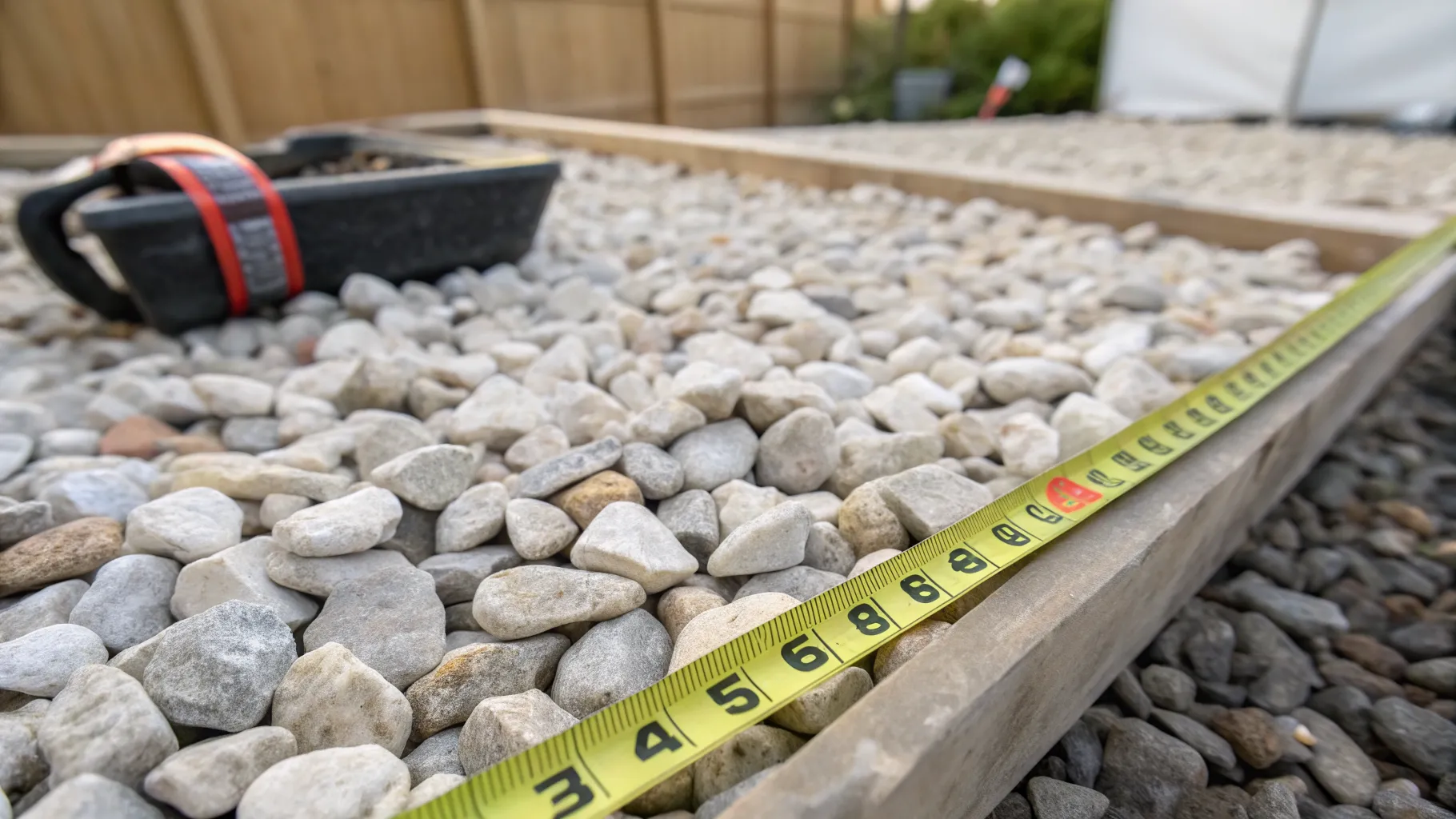
Enter your area in square metres, or a length and width, then pick a depth. This gravel calculator works out the tonnes you need, then converts that into bulk bags and 25kg bags so you can order the right amount in one go.
Gravel calculator
40 to 50mm is the usual depth for paths and drives.
Most 20mm decorative gravel sits around 1.75 t/m³.
The result includes a 5% wastage allowance, which covers settling, raking out and slightly uneven ground. Order in whole bulk bags where you can, since loose tipped gravel and bulk bags usually work out cheaper per tonne than lots of 25kg bags.
Find a building supplier near you
Compare local builders merchants and aggregate yards for gravel and decorative chippings.
How it is calculated
Gravel is sold by weight (tonnes or kilograms), but you measure your space by area and depth. The calculator bridges the two with one formula:
Tonnes = area (m²) × depth (mm) ÷ 1000 × density (t/m³)
Breaking that down:
- Area is your square metres. If you only know length and width, area is length × width.
- Depth is converted from millimetres to metres by dividing by 1000, so 50mm becomes 0.05m. Area × depth gives the volume in cubic metres (m³).
- Density turns volume into weight. Loose 20mm gravel is roughly 1.5 to 1.8 tonnes per cubic metre, and we use 1.75 t/m³ as the default for typical decorative gravel.
We then add a 5% wastage allowance for settling, raking and uneven ground, and convert the total into bags:
- Bulk (jumbo) bags hold about 0.8 tonnes each, so tonnes ÷ 0.8, rounded up.
- 25kg bags are tonnes × 1000 ÷ 25, rounded up.
Worked example
Say you have a path that is 4m long and 3m wide, so the area is 12 m², and you want 50mm of 20mm gravel.
- Volume = 12 m² × 0.05m = 0.6 m³
- Tonnes before wastage = 0.6 × 1.75 = 1.05 t
- Tonnes with 5% allowance = 1.05 × 1.05 = 1.10 t
- Bulk bags = 1.10 ÷ 0.8 = 1.38, rounded up to 2 bulk bags
- Or 25kg bags = 1.1025 × 1000 ÷ 25 = 44.1, rounded up to 45 bags
One bulk bag covers roughly 10 m² at 50mm, so for a small job a single bag often does it, and the calculator rounds up so you never come up short.
Frequently asked questions
How does this gravel calculator work in m²?
Enter your area straight into the m² field, set the depth (40 to 50mm is normal for paths and drives), and the gravel calculator multiplies area by depth and by the gravel density to give tonnes, then splits that into bulk bags and 25kg bags. If you do not know the area, switch to length x width and it works it out for you.
How do I use the 20mm gravel calculator?
For 20mm gravel, leave the density on the 1.75 t/m³ setting, which is the standard figure for loose 20mm decorative aggregate. Pick a depth of around 50mm so the stones knit together and cover the ground without showing the membrane underneath. The calculator does the rest.
How many tonnes of gravel do I need?
Multiply your area in square metres by the depth in metres to get cubic metres, then multiply by about 1.75 to get tonnes. For example, 20 m² at 50mm is 20 × 0.05 × 1.75 = 1.75 t before wastage. The calculator above adds a 5% allowance on top so your order has a little headroom.
How many bulk bags of gravel do I need?
A bulk bag holds about 0.8 tonnes and covers roughly 10 m² at 50mm deep, or nearer 12 to 14 m² at a shallower 35 to 40mm. Divide your total tonnes by 0.8 and round up. The calculator shows the whole-bag count directly so you can order bags rather than convert by hand.
How many 25kg bags of gravel make a bulk bag?
A 0.8 tonne bulk bag is 800kg, which is 800 ÷ 25 = 32 small bags. Bulk bags are almost always cheaper per tonne, so 25kg bags are best kept for small top-ups, planters and tight access where a bulk bag cannot be craned or barrowed in.
What depth of gravel should I lay?
For decorative areas and footpaths, 40 to 50mm over a weed membrane is plenty. For a driveway that takes car weight, aim for around 50mm of gravel over a compacted sub-base, not gravel on its own. Going much deeper than 50mm on top makes the surface loose and hard to walk on.
How much area does a tonne of gravel cover?
At 1.75 t/m³, one tonne is about 0.57 m³ of gravel. Spread at 50mm that covers roughly 11 m², or about 14 m² at 40mm. Deeper layers cover less area per tonne, which is why the depth setting changes the result so much.
Is this gravel calculator accurate for the UK?
Yes. It uses metric units (m², mm, tonnes), UK bulk bag and 25kg bag sizes, and the 1.5 to 1.8 t/m³ density range that UK suppliers quote for 20mm gravel. Treat the figures as a planning estimate and confirm the exact bulk bag weight with your supplier, since these vary a little by yard.