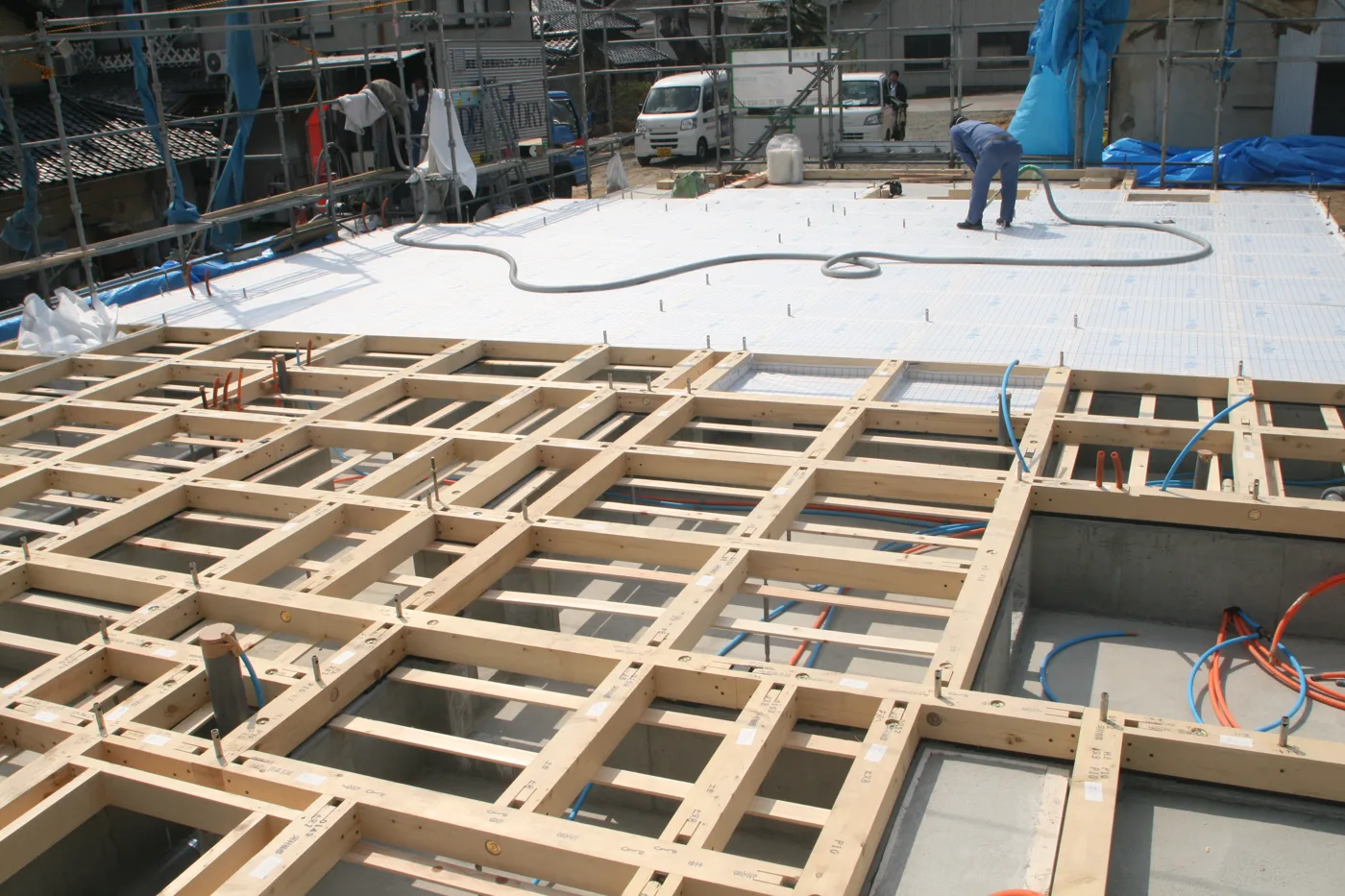
The size of joist you need depends on three things: how far it has to span, how close together the joists sit, and the strength grade of the timber. Get those three right and the floor feels solid underfoot. Get them wrong and it bounces, sags, or fails Building Control.
This guide explains the grades you will see at the merchant (C16 and C24), the common joist sizes from 47x100 up to 47x225, and how spacing at 400, 450 or 600mm centres changes how far each joist can reach. The span figures here are a realistic guide for a standard domestic floor, but they are not a substitute for the official span tables or an engineer’s calculation. More on that below.
If you already know your sizes and just want quantities, you can work out exact lengths and the number of joists with our Timber and Joist Calculator.
C16 vs C24: what the grade means
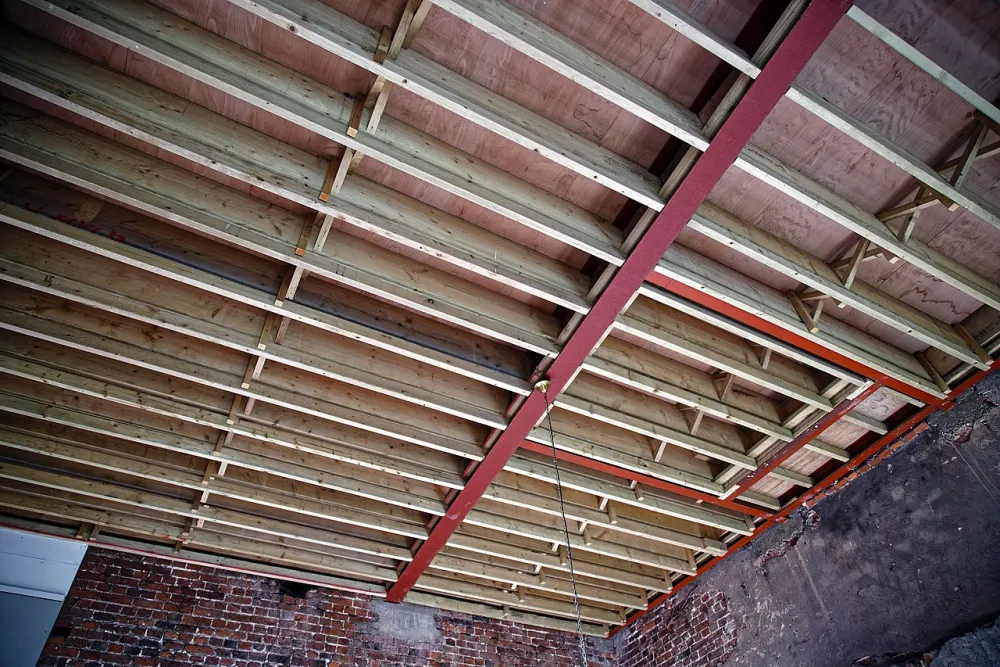
Structural softwood in the UK is strength graded and stamped with a class. The two you will meet for domestic floors are C16 and C24, both defined by BS EN 338. The number is the timber’s bending strength in newtons per square millimetre, so C24 is stronger than C16.
In rough terms, C24 is around 50 percent stronger in bending and stiffer than C16. Stiffness matters as much as strength for a floor, because a floor that does not break can still feel bouncy if it deflects too much. For the same joist size, C24 will span further before it hits the deflection limit.
- C16 is the cheaper, more common general carcassing grade. Plenty of domestic floors are built in C16 and it is fine where the span is modest.
- C24 carries a price premium of roughly 15 to 25 percent over C16, but buys you extra span from the same depth of timber. It is the grade many merchants now stock as standard for joists.
Whichever you use, the timber must be graded and marked. An unmarked offcut with no grade stamp has no recognised structural value, and Building Control will want to see the grade.
Width: 38mm or 47mm
Joists come in two standard widths, 38mm and 47mm. The 47mm width is now the usual choice for floor joists and is what most merchants stock for structural work. The extra width adds a little strength and gives a better fixing edge for boards and plasterboard. Throughout this guide the sizes are quoted as 47mm wide.
Common floor joist sizes
Joist depth is what does most of the work. A deeper joist spans much further than a shallow one of the same width, which is why you size up the depth as the span grows.
| Size (width x depth) | Old imperial name | Typical use |
|---|---|---|
| 47 x 100mm | 4 x 2 | Short spans, small rooms, decking-style framing |
| 47 x 125mm | 5 x 2 | Short to medium spans |
| 47 x 150mm | 6 x 2 | Common for small to medium rooms |
| 47 x 175mm | 7 x 2 | Medium spans, very common in houses |
| 47 x 200mm | 8 x 2 | Larger rooms, the everyday workhorse |
| 47 x 225mm | 9 x 2 | Longer spans before you move to engineered joists |
If a span needs something deeper than 47x225 solid timber, builders usually switch to engineered I-joists or steel rather than trying to find ever larger sections of softwood.
How spacing changes the span
Joists are set at regular centres, which is the distance from the centre of one joist to the centre of the next. The three common spacings are:
- 400mm centres (the closest of the three, most timber per floor, the longest span)
- 450mm centres (a middle option, used to suit some board sizes)
- 600mm centres (the widest, least timber, the shortest span)
The logic is simple. Pack the joists closer together and each one carries less of the floor, so it can reach further. Space them out and each joist carries more, so its span drops. Spacing is also tied to your floor boards: chipboard flooring is made to suit joists at specific centres, so the spacing and the decking go together.
Floor joist span tables (a guide)
The tables below show maximum clear spans for a standard domestic floor: an imposed (live) load of 1.5 kN/m2 and a dead load in the region of 0.25 to 0.50 kN/m2, which covers chipboard decking and a plasterboard ceiling. Clear span means the open distance the joist crosses between supports, not the length of timber you buy.
C16 floor joists
| Size | 400mm centres | 600mm centres |
|---|---|---|
| 47 x 100mm | 1.72m | 1.52m |
| 47 x 125mm | 2.24m | 1.98m |
| 47 x 150mm | 2.76m | 2.46m |
| 47 x 175mm | 3.20m | 2.88m |
| 47 x 200mm | 3.64m | 3.22m |
| 47 x 225mm | 4.04m | 3.54m |
C24 floor joists
| Size | 400mm centres | 600mm centres |
|---|---|---|
| 47 x 100mm | 2.02m | 1.82m |
| 47 x 125mm | 2.62m | 2.34m |
| 47 x 150mm | 3.20m | 2.86m |
| 47 x 175mm | 3.72m | 3.34m |
| 47 x 200mm | 4.18m | 3.74m |
| 47 x 225mm | 4.62m | 4.12m |
Two patterns stand out. Going from C16 to C24 buys you a useful step in span at the same size: a 47x200 at 400mm centres jumps from about 3.64m to 4.18m. And tightening the spacing from 600mm to 400mm adds span at every size. The 450mm figures sit between the two columns shown.
These are guide values. The official spans depend on the exact load case and come from the TRADA span tables (published by Timber Development UK) that sit behind Building Regulations Approved Document A. Use the table above to get in the right ballpark, then confirm before you buy.
How to pick a joist size
- Measure the clear span. Take the open distance, in metres, between the walls or beams the joists will rest on; in a cavity wall that bearing support is usually the inner-leaf blockwork. This is the number that drives everything.
- Decide the grade. C16 if the span is comfortable for the depth you want, C24 if you need more reach from the same depth or want margin.
- Pick a spacing. 400mm centres for the longest span and a stiffer floor, 600mm to save timber on shorter spans, 450mm where your board layout suits it.
- Read across the table to find the smallest size whose maximum span comfortably beats your clear span. Leave a margin rather than sizing right to the limit.
- Confirm it. Check your chosen size against the current span tables for your actual loads, and get a structural engineer’s calculation for anything non-standard: heavy partitions over the floor, a bath or large tank, notched or drilled joists, openings for a stairwell, or unusual spans. Building Control will expect the floor to be properly sized.
When you have the size and span settled, work out the timber lengths and how many joists you need across the room with our Timber and Joist Calculator.
What floor joist timber costs
Prices vary by region, supplier, section size and whether you have a trade account, so treat these as a 2026 guide and get a live quote from your merchant. A trade account and buying by the pack can knock a fair bit off the shelf price.
As a rough picture for treated, regularised carcassing in 4.8m lengths:
- 47 x 100mm C16: around £7 to £10 per length
- 47 x 150mm C24: around £15 to £20 per length
- 47 x 200mm C24: around £19 to £24 per length
C24 carries that 15 to 25 percent premium over C16 for the same size. Across a whole floor the grade choice adds up, so it is worth checking whether C16 spans your room before paying for C24. (Builders Merchants Direct, TradeCalculator)
Find a timber merchant near you
Compare local builders merchants for C16 and C24 carcassing, by the length or the pack.
FAQ
What is the difference between C16 and C24 joists?
Both are strength-graded structural softwood. C24 is roughly 50 percent stronger and stiffer than C16, so it spans further at the same size, and it costs about 15 to 25 percent more. C16 is the cheaper general grade and is fine for shorter spans.
How far can a 47x200 joist span?
For a standard domestic floor at 400mm centres, a 47x200 spans roughly 3.64m in C16 and 4.18m in C24 as a guide. The exact figure depends on the load and spacing, so confirm against span tables for your job.
Does closer joist spacing let me span further?
Yes. Joists at 400mm centres span further than the same size at 600mm centres, because each joist carries less floor. The trade-off is more timber and more joists per room.
Do I need a structural engineer for floor joists?
For a simple, standard floor you can often size from the published span tables. Get an engineer’s calculation for anything non-standard: long spans, heavy loads over the floor, notched or drilled joists, a stairwell opening, or where Building Control asks for it.
What is the most common floor joist size in UK houses?
47x175mm and 47x200mm are the everyday sizes for typical rooms. Smaller rooms may use 47x150mm, and longer spans push you to 47x225mm or engineered I-joists.
Work out your timber
Once you have the size, grade and spacing, the next step is quantities: how long each joist needs to be and how many run across the room. Enter your room dimensions and spacing and get the timber list with our Timber and Joist Calculator.